Liquid-service purge / mounting assembly review
+ Quoted after process review
Confirm the rated wetted boundary and compatible purge gas. Do not inject air into an inerted or flammable vessel.
Include in RFQNON-CONTACT · FMCW
Keep the sensing element above the process. Specify a lens antenna, process seal and signal path around your chemical tank, reactor or narrow mounting nozzle.
Configure RLS-80G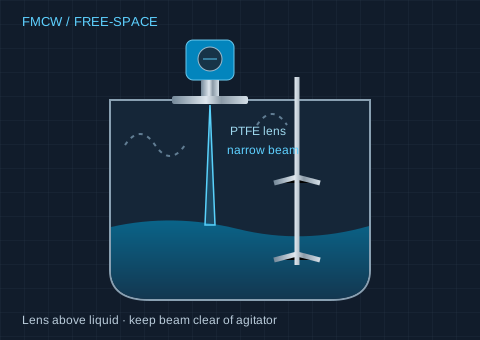
CONFIGURATION REQUEST · RLS-80G
Chemical storage · reactors · solvent tanks · IBC vessels
| Selection parameter | Enquiry scope |
|---|---|
| Measurement path | 80GHz FMCW, free-space |
| Antenna request | Flush PTFE lens; exact wetted assembly to confirm |
| Accuracy target | ±1 / ±2 mm, configured model and conditions required |
| Beam target | 3–4°; depends on antenna aperture |
| Connection request | 1.5 in NPT / G1.5; ASME or DN flange |
| Output request | 4–20 mA + HART or RS485 Modbus; variant dependent |
Values labelled targets are sourcing requests, not released ratings. Range, precision, probe, pressure, temperature and approvals must be confirmed together for the exact ordered variant.
INSTALLATION REVIEW
Provide nozzle inside diameter, length and distance to coils, ladders and agitator sweep.
PTFE lens does not establish the chemical compatibility of seals, flange or complete wetted assembly.
Condensation, coating and weak dielectric reflections still need echo evaluation and a clean line of sight.
Define required blocking distance and near-full level. Do not assume zero dead band.
OPTIONAL ASSEMBLIES
+ Quoted after process review
Confirm the rated wetted boundary and compatible purge gas. Do not inject air into an inerted or flammable vessel.
Include in RFQ+ USD 45
Confirm module/app and hazardous-area permissions. Do not open an Ex enclosure or use radio contrary to issued instructions.
Include in RFQIndicative USD allowances. Base sensor, freight and taxes excluded; final configuration and pricing require quotation.
ENGINEERING QUESTIONS
Metal obstructs microwave paths. A narrow beam can be positioned between internals, but does not pass through metal blades or guarantee freedom from false echoes.
Specify your safety function, required certification and proof-test procedure. A standard level transmitter alone does not establish SIL or API 2350 compliance.
MAKE THE PROCESS THE STARTING POINT
Media, range, temperature, pressure, nozzle and output requirements help define an offer you can evaluate.